TOMASZ
A Tour of his Art Works Reflecting Poland and Judaism

I. INTRODUCTION
My eye caught a drawing. Rather it was the drawing that caught me. I asked the artist about whom he drew and captured so well in the piece. He said it was Reb Ben Zion Halberstam, the Second Rebbe of the Bobover Hasidim, who was murdered by the Nazis.
Tomasz Krawczyk, the artist, captured the Rebbe's essence, his nishama. I wanted to bid on it during the auction, but Tomasz told me the item was sold. I was too late to bid for this piece.
This all took place at the 2022 Jewish Festival at Mszana Dolna, a night before the town was to commemorate, for the first time, the 80th anniversary of the liquidation1 of the Jewish residents of the town that took place during the war. Along with the locals, the organizer of this event, Urszula and Marek Rekucki, invited the descendants of the victims and survivors to be part of this event.

This is where I met Tomasz for the first time. All of his artwork was impressive, but the drawing of the Rebbe was more than just paper and carbon. It especially resonated because my Great Grandfather, whom my Mother adored and spoke of a lot, was the Patriarch of the family and a notable of this Rebbe's court.
Tomasz and I got to know each other during this occasion. He is not Jewish. I thought he was because much of his artwork was Judaic from the soul, or rather that's how I interpreted it. He did tell me that there is Jewish lineage, Yichus, in his family and described that family tree to me.
The story of Tomasz is the story of modern-day Poland since the fall of communism. During the nearly forty-five years of communism, many Jews needed to keep their identities silent. During the War, being a Jew meant a certain death sentence. For those that lived in Poland after the War, many chose to keep their Judaism silent for that reason. During communism, there were three major times of overt state sponsored antisemitism.
At the turn of the millennium, many elderly Poles "confessed" to their children as to the Jewish lineage in their families. For many, this created a question of identity. Many Poles consulted with the Chief Rabbi and his staff, and the Chief Rabbi, Michael Schudrich, extended himself fully to them.
This news strengthened the identity of many Poles. To others, confusion, and yet others, hostility. Thankfully, many people were able to navigate both identities. It was the story of Poland: present and past.
Tomasz was a reflection of that history.
The best way to understand Tomasz is to take a pictorial tour of his Gallery below:
II. The Bobover Rebbe, Reb Ben Zion Halberstam ZT”L
Twice I commissioned Tomasz to recreate the first drawing of the second Bobover Rebbe. The first time I sent an email to him was shortly after I came back home from the 80th Anniversary Memorial Yahrzeit. He was only too happy to oblige.
The second time I commissioned him was this past November. I wanted to surprise my Chavrusa2 partner, Yossie. Yossie is also Bobover, and his family who were from Poland, were also important in the Rebbe's court.

Every drawing of the Second Bobover Rebbe that Tomasz recreated was more powerful than the previous one.
III. THE GREETING CARD
Outside of the Bobover Rebbe, and another drawing that will be shown shortly, this is my favorite drawing.
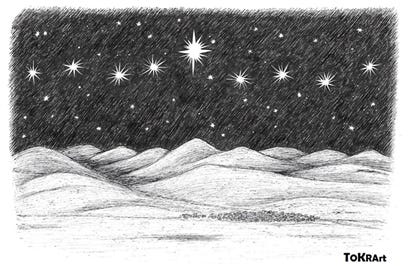
I love mountains, and you can see a small village in the valley. I can never order it because of the Star of Bethlehem showing on the top center. It's a religious card.
To my surprise, my friends, upon viewing the card for the first time, immediately saw a Chanukah Menorah. They pointed out the eight lights of Chanukah on either side of the main candle, the Shamash. It took me awhile, but I finally noticed it. On the other hand, it took them a while to notice the Star of Bethlehem.
This drawing depicts Tomasz. His esthetics, his dual past, his sensitivity, and his warmth.
If an American artist drew this, I would find this offensive. This artwork is from a modern-day Polish artist. I see him in his art, and I get it.
IV. ANOTHER GREETING CARD
Below is another greeting card that Tomasz sent me this year. He always sends an additional drawing or, in this case a greeting card, with the artwork that I have ordered from him.
In this case, the name of the original work was called "Darwinistisches”, and it was created by Cohn and displayed in the 1904 German-Jewish magazine, "Schlemiel".
The Cohn family converted from Judaism to Christianity. During the turn of the twentieth century, years before the advent of Nazism, there was an atrocious merging of racial theory and Darwinism. Jews were considered the inferior race.

"Darwinistische" shows the transformation of a Chanukah menorah into a full-fledged Christmas tree. Think of the famous Darwinist poster displaying the evolution of the ape to homo sapiens. Both are very similar in message.
Tomasz took this original, dull, monochrome piece and colorized it. He gave it life. He knew instinctively how I would feel about it and wrote to me in his letter, “…On the other hand, looking at this evolution in Hebrew – from right to left – one can come to completely different conclusions….”.
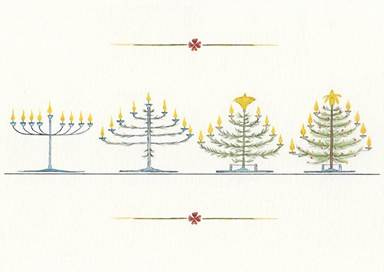
Again, this is a pure Tomasz re-creation that came from his heart.
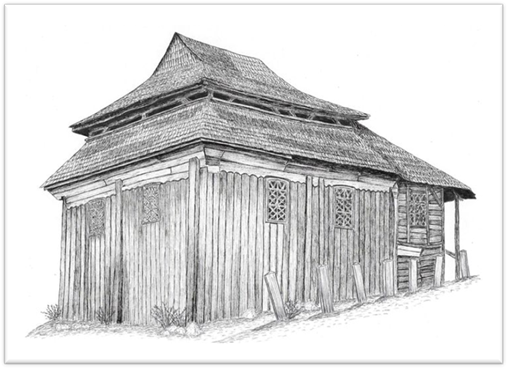
V. OTHER CREATIONS:

VI. A WONDERFUL GIFT:
With the drawing of the Bobover Rebbe, Tomasz surprised me with this water color.

It is of Mszana Dolna. To the left one could see the main church of the town, St. Michel. My Mother, her Grandfather, and his family lived in the family estate across the street from the church.
On the bottom right, one sees an old locomotive riding out of town.
That image sent a shudder down my spine. The first time I was in Mszana Dolna was in 2001. It was in front of the old Jewish Cemetery. Suddenly, down the incline, I heard and then saw an old freight train ride out of town. The imagery of trains, at that very moment, was very disturbing and symbolic to me.
How Tomasz knew to include the train, I do not know. However, it did belong in this water color.
VII. THE PATRIARCH OF THE FAMILY: REB SCHULEM GELLER Z"L
The only photograph I have of my Great Grandfather stands prominently and within easy view, in my house. As mentioned, I heard a lot about him over the decades. I am always glancing at it. It connects me, and reminds me of who I am.

This past November, I asked Tomasz to create a drawing from the photo and provided him with background information about this man. In February he completed the project. To my surprise, he only drew his face. I did not know what to make of it. I also wasn't sure about the outcome. I only saw the drawing through a PDF copy of the drawing via email. A PDF copy does not do the artwork justice.
This I did learn about Tom, and artists in general when I worked in Greenwich Village. First, you have to trust them. If you do not trust them, do not commission them. Second, you have to provide them with artistic license. They are not to be micromanaged. Not once during the months that he was commissioned, did I call him for an update. That is how much I trusted him.
He sent me the drawing. It was sitting on my desk for two days in a closed box. After I had the courage to open it, I wrote him this letter:
“I then looked at my Great Grandfather. Notice I deliberately did not say a ‘drawing’ of my Great Grandfather. I felt I was looking right at him. His energy came right out at me. When I first saw it, I gasped and then I smiled. It was perfect.”

VIII. TOMASZ, THE PERSON:
Tomasz and I keep regularly in touch. He is such a good warmhearted person.
As mentioned, he does not consider himself Jewish, but I believe he has a 'Pintele Yid' in him, a tiny Jewish flame still burning within him. Pintele Yid really applies to highly assimilated Jews, but in this part of the twenty first century, I have found it, in various forms, in Poland.

Look at Tomasz's creations. They are clearly works of Judaica.
IX. The Cemetery Projects:
Tomasz is very much involved, and on the forefront of restoring the old Jewish cemetery in Myslenice.3
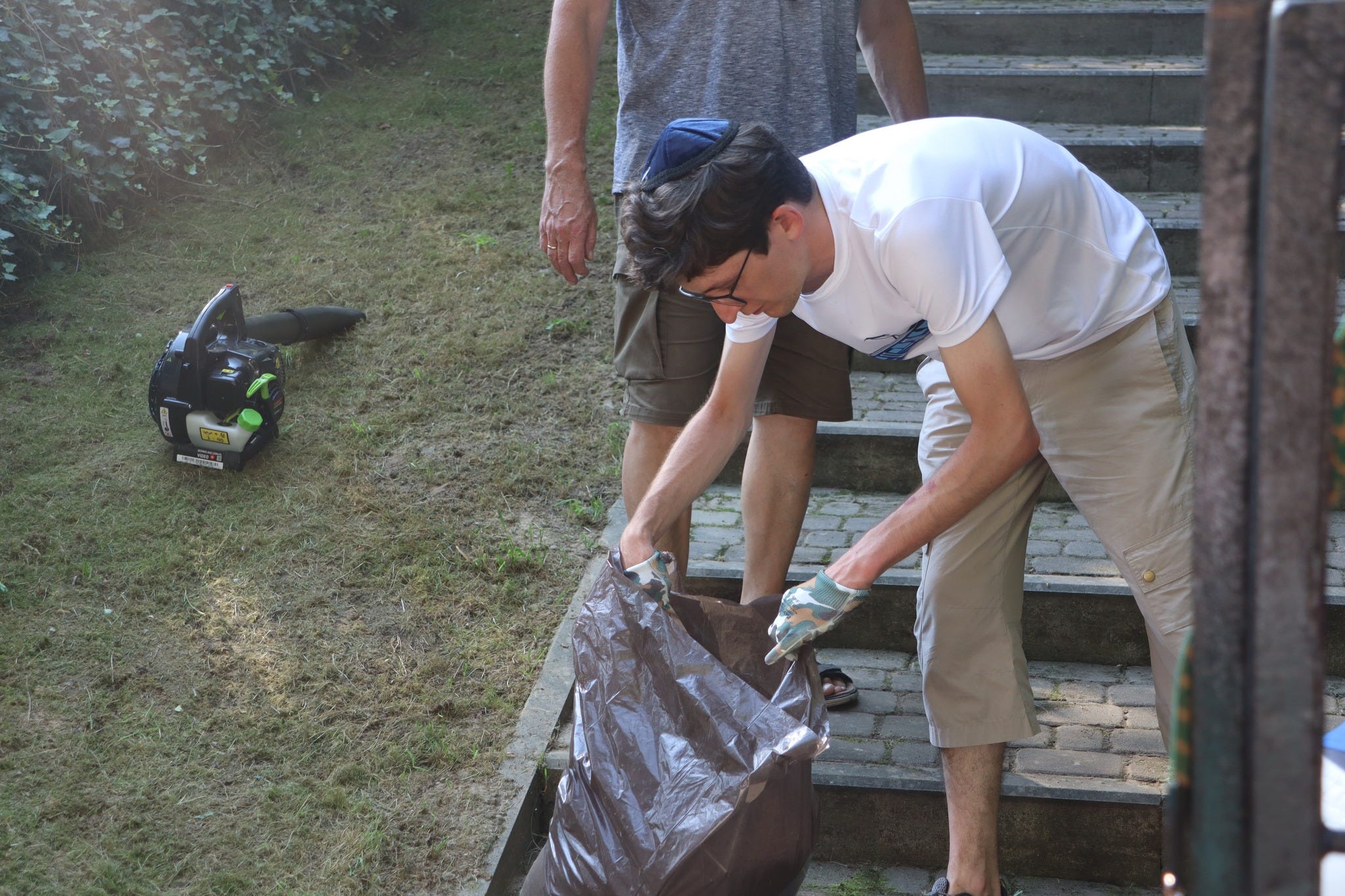
He also volunteers with group to regularly clean the old Jewish cemetery and mass grave sites at Mszana Dolna (see photo above).
X. THE PHD CANDIDATE TOMASZ, THE NEXT MARK PODWAL?
Tomasz may be an artist, but he is a psychologist and PhD candidate in Health Sciences (Bioethics) at the Department of Bioethics, Jagiellonian University Medical Center.4 I told him that his focus may be in obtaining his doctorate, but his passion has to be his art.
In one of my correspondences to him, I wrote that Tomasz reminded me of Mark Podwal, the famous artist and illustrator5. Dr. Podwal’s works were and still are shown all over the world at the major museums and venues. Plus his illustrations were in some of Elie Wiesel’s books.
Like Tomasz, I first came across Podwal’s works at a Jewish street fair at the Upper West Side in Manhattan during the 1970s. A young man set up an unauthorized bridge table in the middle of the street and started selling these hand made Rosh Hashanah cards. Crowds surrounded the table, including me, buying these unique works of art. Podwal’s brother was the seller, and I am sure, we all became Podwal admirers.
Like Tomasz, Mark Podwal was a reknown doctor, a dermatologist. His art was his sidebar, but in a major way.
My hope is that Tomasz’s art will have that international effect. He has the ability to bringing forth the past. Thank you Tomasz.
For more about this Memorial Event refer to my three part series in Substack titled, “The Ingathering of the Exiles in Exile”.
Group study.
Tomasz’s name displays prominently in this document: http://cmentarze-zydowskie.pl/myslenice_matzevot.pdf
For more about Tomasz’s academia, refer to: https://krawczyktomasz.wordpress.com/
About Mark Podwal, https://www.markpodwal.com/
What a special connection you have with this unique soul.